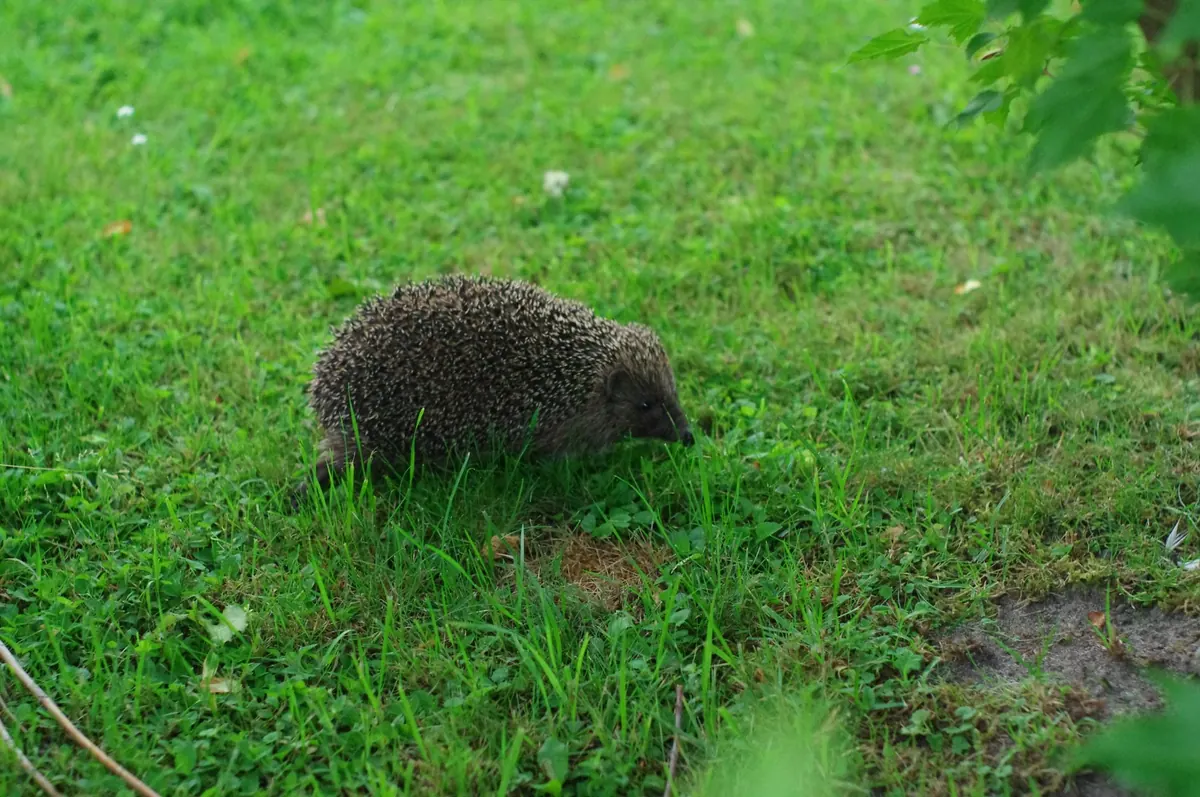
How to Build a Hedgehog Highway Through Your Woodland Garden
A hedgehog can cover a mile or more in a single night, working the same rough circuit between gardens, allotments, churchyards and the edges of woodland. That circuit only holds together while the ground stays connected. Fences, walls, kerbs and tightly fitted gravel boards slice it into fragments, and a hedgehog that meets a solid barrier will usually turn back rather than look for a way round. The remedy is surprisingly modest: a handful of small, well-placed gaps joined up by planted cover. Put those in place and you have built a hedgehog highway.
Why a gap beats a bigger garden
Hedgehogs are not territorial in the way people often imagine. A single animal may use several gardens in a week, and a good night's foraging can take it across a dozen boundaries. It cannot climb a fence or squeeze beneath a tight gravel board, so a garden sealed all the way round becomes a cage — pleasant enough, but a small one.
Connecting your garden to the next one does more for hedgehogs than making your own plot twice as good. Numbers across Britain have fallen sharply over recent decades, and the fragmentation of gardens and hedgerows is one of the reasons. Every gap you cut works against that.
Sizing and placing your gaps
The accepted benchmark is a gap about 13cm square, roughly the size of a CD case. That lets an adult hedgehog through comfortably while keeping most dogs and cats out. Smaller will not do; a hedgehog is broader than it looks, and a half-hearted notch in a gravel board simply wastes your time.
Where you put it matters as much as the size:
- Ground level, always. A hole 10cm up a fence panel is no use to an animal that walks.
- No lip or step. Square the bottom of the opening off with the soil and clear any build-up of gravel.
- Near cover. A gap on an exposed, floodlit stretch of patio will be avoided; one beside a shrub border will be used within days.
- One per boundary, at least. If a boundary runs more than 20 metres, consider a second gap.
- Aligned with your neighbour's gap. Two openings a few metres apart on the same fence line are far less useful than two directly opposite each other.
Cutting the opening
Different boundaries need different approaches. In a featherboard panel, a notch cut with a jigsaw or padsaw near the bottom of a board is quick, and the cut edge can be capped with a scrap of timber to keep it neat. Where a fence has a concrete gravel board, cutting a section out with an angle grinder works, but wear eye protection and keep the cut square. In a hedge or shrub line, simply leave or open a 15cm gap at ground level. In a dry stone wall, lift out a stone or two near the base.
With brick or block walls, remove enough to leave the 13cm opening, then check what is above. Any wall carrying a load needs professional advice before you take material out of it. If in doubt, run the route around the end of the wall instead.
Tunnels for walls, gates and kerbs
Where cutting is impossible, a short tunnel through the base of the obstruction works well. Use a rigid pipe of about 13cm internal diameter, or one of the ready-made hedgehog tunnels sold by wildlife suppliers. Keep the run short and straight so daylight is visible at the far end, set the floor flush with the ground on both sides, and bed the pipe in so it cannot roll or be knocked out of line. A tunnel that ends in a drop, a pond or a concrete apron is worse than no tunnel at all.
Tunnels under a road or a driveway are a different matter and are not a garden project. If a road separates two good hedgehog areas, that is a job for the local authority or a wildlife group.
Planted corridors
A highway of gaps through bare, tidy ground gives a hedgehog nowhere to nest, forage or hide. Link the gaps with a ribbon of cover instead. A native hedge of hawthorn, blackthorn, hazel, field maple or dog rose is ideal, and it can be trimmed or laid to suit the space. Underneath, allow a rough grass margin, some leaf litter and a few patches of bramble or honeysuckle.
Log piles, brushwood heaps and stacked prunings do double duty: they shelter beetles and slugs, which hedgehogs eat, and they offer a dry place to sleep. Keep hedge trimming to late winter where you can, outside the bird nesting season, and never strim the base of a hedge without checking it first.
Keeping the route safe
A gap that leads into danger is not a highway. Walk your route and look at it from a hedgehog's height:
- Avoid slug pellets, which harm hedgehogs and the creatures they feed on. Beer traps, nematodes and hand-picking are better options.
- Give ponds, water butts and steep-sided troughs an escape route — a sloped edge, a plank, or a ramp of stones. Hedgehogs swim well but cannot climb smooth sides.
- Raise netting, including pea netting and football nets, and keep it taut so nothing can tangle in it.
- Cover or fence light wells, drains and gravel traps, or fit a ramp.
- Check long grass and log piles before strimming, and check bonfires before lighting them.
A shallow dish of water is always welcome, particularly in dry spells. If you feed hedgehogs, use tinned cat or dog food or a proprietary hedgehog food, and never milk or bread.
Map it, then rope in the neighbours
Sketch your boundaries and mark where each gap sits. It takes ten minutes and makes the next stage easier, because a highway only becomes useful when it crosses more than one garden. Talk to the people on either side, explain the 13cm rule, and offer to cut the gap yourself. Most will say yes once they know it will not let the dog out.
National campaigns such as Hedgehog Street, run by wildlife organisations, offer templates and neighbour letters if you want something in writing. Once the gaps are in, check them each spring; soil, gravel and new growth all creep in over winter.
Start with one gap
Pick the boundary most likely to be used, cut a 13cm square opening at ground level, and clear the approach on both sides. Put a handful of leaves and a log nearby so the hedgehog has cover at the door. Then repeat the job on the opposite side of the garden next month. One gap is a start; four in a row is a route.
Photo: Daniel Brzeziński / Pexels